
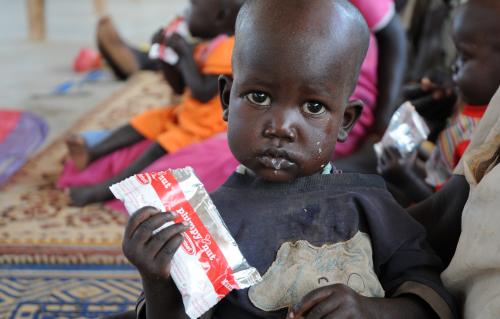
Across Africa, millions of children are caught in the crossfire of wars, insurgencies, and communal violence. Beyond bullets and bombs, one of the most devastating consequences of conflict is hunger. When farms are abandoned, markets collapse, and families are forced to flee, food insecurity quickly escalates into a life-threatening crisis—especially for young children.
In these fragile environments, Ready-to-Use Therapeutic Food (RUTF) has emerged as one of the most powerful tools to combat severe acute malnutrition (SAM). Compact, nutrient-dense, and easy to administer without the need for refrigeration or clean water, RUTF offers a lifeline to children who might otherwise not survive.
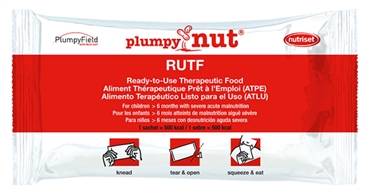
What is RUTF?
RUTF stands for Ready-to-Use Therapeutic Food—a life-saving, nutrient-dense paste designed to treat severe acute malnutrition (wasting) in children under five. Wasting occurs when a child is dangerously underweight for their height due to prolonged lack of adequate food or poor diet quality, and if untreated, it dramatically increases the risk of death.
RUTF is typically made from peanuts, milk powder, sugar, vegetable oil, and a fortified mix of vitamins and minerals, providing both energy and essential nutrients. The most widely recognized brand is Plumpy’Nut, though other international and locally based producers manufacture similar formulations across Africa and beyond.
Key Features of RUTF:
- Ready to eat – no cooking, mixing, or clean water needed.
- Nutrient-rich – provides the calories, protein, and micronutrients essential for recovery.
- Long shelf life – can be safely stored for up to two years, even in hot climates.
- Portable – easy to distribute and consume in conflict zones or during displacement.
- Appealing taste – sweet and palatable, encouraging children to eat it directly from the sachet.
| For 100g of product | ||||||
| Moisture content | 2.5% maximum | |||||
| Water activity | 0.2 to 0.5 | |||||
| Energy | 520-550 kcal | |||||
| Proteins | 10-12% total energy equivalent to 12.8-16.2% by weightDairy products shall contribute to at least half of the protein content. | |||||
| Lipids | 45-60% total energy equivalent to 25.8-36.3% by weight | |||||
| n-6 fatty acids | 3-10% total energy | |||||
| n-3 fatty acids | 0.3-2.5% total energy | |||||
| Trans-fatty acids | <3% total fat | |||||
| Fibre | <5% | |||||
| Vitamins | Minerals | |||||
| Vitamin A | 0.8-1.2mg mg RE | Sodium | 290 mg maximum | |||
| Vitamin B1(Thiamine) | 0.5 mg minimum | Potassium | 1100-1400 mg | |||
| Vitamin B2(Riboflavin) | 1.6 mg minimum | Calcium | 300-600 mg | |||
| Vitamin B3(Niacin) | 5 mg minimum | Phosphorous (expressed in non-phytate phosphorus) | 300-600 | |||
| Vitamin B5(Pantothenic acid) | 3 mg minimum | Magnesium | 80-140 mg | |||
| Vitamin B6(Pyridoxine) | 0.6 mg minimum | Iron | 10-14 mg | |||
| Vitamin B7(Biotin) | 60 mcg minimum | Zinc | 11-14 mg | |||
| Vitamin B9(Folic acid) | 200 mcg minimum | Copper | 1.4-1.8 mg | |||
| Vitamin B12(Cyanocobalamin) | 1.6 mcg minimum | Selenium | 20-40 mcg | |||
| Vitamin C(Ascorbic acid) | 50 mg minimum | Iodine | 70-140 mcg | |||
| Vitamin D (Cholecalciferol) | 15-20 mcg | |||||
| Vitamin E(Tocopherol) | 20 mg minimum | |||||
| Vitamin K (Phytonadione) | 15-30 mcg | |||||
Each sachet of RUTF contains about 520-550 calories and is carefully formulated to help malnourished children gain weight quickly and safely.
Origins of RUTF
RUTF was pioneered over 25 years ago by French pediatric nutritionist André Briend and food processing engineer Michel Lescanne, and became commercially available in the early 2000s. Since then, it has revolutionized the treatment of child malnutrition, especially in humanitarian emergencies where conventional food aid may not meet children’s nutritional needs.
Global Use of RUTF
For the past four years, UNICEF has procured around 75–80% of the world’s RUTF supply—roughly 49,000 metric tons annually. Between 2017 and 2021 alone, UNICEF delivered about two million cartons to South Sudan, underscoring its vital role in conflict-affected countries.
Because of its effectiveness, durability, and ease of use, RUTF has become an essential tool in humanitarian nutrition programs, ensuring that even in the most challenging environments, children have a chance to survive and recover.
The Scale of Malnutrition in Conflict Zones
Sub-Saharan Africa carries one of the highest burdens of child malnutrition globally, and conflicts only worsen the crisis. According to UNICEF and the World Food Programme (WFP):
- More than 45 million children under five suffer from wasting worldwide, with Africa accounting for a significant share.
- Conflict-affected countries like South Sudan, Nigeria, Somalia, and the Democratic Republic of Congo (DRC) consistently record some of the world’s highest rates of severe acute malnutrition.
- Children in conflict zones are twice as likely to be malnourished compared to those in stable environments.
The situation is further compounded by climate shocks—such as droughts and floods—that often occur alongside armed conflict, leaving families with no safety net.
RUTF in Action: Case Studies from African Conflict Zones
1. Nigeria’s Northeast (Borno, Adamawa, and Yobe States)
The Boko Haram insurgency has displaced millions and disrupted agricultural production. Camps for internally displaced persons (IDPs), such as Bakassi Camp in Maiduguri, struggle with overcrowding and food shortages. Humanitarian agencies like UNICEF and Médecins Sans Frontières (MSF) use RUTF to save the lives of thousands of children suffering from SAM.
2. South Sudan
In South Sudan, years of civil war have created one of the most severe food insecurity crises in the world. At Bentiu Protection of Civilians (PoC) site, RUTF distribution has been central to nutrition interventions. For many children, Plumpy’Nut is the only reliable source of nutrition during prolonged periods of displacement.
3. Somalia
Somalia has faced a toxic mix of conflict and recurrent drought. RUTF has been scaled up as part of community-based management of acute malnutrition (CMAM). Mothers can take sachets home and feed their children without having to stay long in clinics, reducing exposure to insecurity.
Challenges to RUTF Availability in Conflict Settings
Despite its proven effectiveness, ensuring a consistent supply of RUTF in conflict-affected African countries faces many obstacles:
- Supply Chain Disruptions
Roads, bridges, and transport systems are often destroyed or unsafe due to fighting. This makes last-mile delivery of RUTF extremely difficult. - Dependence on Imports
Much of Africa’s RUTF supply is imported, though local production has been growing. Reliance on imports can lead to delays, higher costs, and stockouts during global supply chain crises. - Funding Gaps
RUTF is expensive compared to staple foods. Humanitarian organizations rely heavily on international donors, but funding shortfalls often mean that not every malnourished child receives treatment. - Security Risks for Aid Workers
In many conflict zones, humanitarian convoys carrying RUTF are targeted by armed groups or face bureaucratic delays at checkpoints. - Stigma and Awareness
Some caregivers initially hesitate to use RUTF because it is unfamiliar or mistaken for ordinary food rather than therapeutic treatment. Community education remains crucial.
Local Production: A Step Toward Sustainability
Encouragingly, several African countries now produce RUTF locally, reducing reliance on imports and supporting national economies. For example:
- Nigeria – Local manufacturers, supported by UNICEF, produce RUTF for the domestic market.
- Ethiopia and Kenya – Have established factories that supply both national needs and neighboring countries.
- Sudan – Has expanded RUTF production through partnerships with NGOs and the private sector.
Local production helps lower costs, creates jobs, and ensures faster delivery to communities in need.
International Humanitarian Law and the Right to Food
It’s important to note that starvation as a weapon of war is prohibited under international humanitarian law (IHL). Parties to conflicts are obligated to protect essential supplies such as food and medicine. The UN Security Council Resolution 2417 also explicitly condemns the use of hunger in warfare.
Yet in practice, access to food—including RUTF—remains obstructed in many African conflicts. Civilians, particularly children, bear the brunt of these violations.
The Way Forward: What Needs to Be Done
To improve RUTF availability in conflict-affected parts of Africa, multiple actions are needed:
- Scale Up Local Production
Expand factories across Africa to ensure regional self-sufficiency. - Secure Humanitarian Access
Governments and armed groups must respect international law and allow safe passage for nutrition supplies. - Increase Funding
Donors must close the gap between needs and available resources for nutrition programs. - Integrate Nutrition into Broader Strategies
RUTF distribution should be part of a wider system that includes water, sanitation, health services, and food security. - Community Engagement
Educating caregivers about the importance of RUTF increases acceptance and ensures proper use.
RUTF as a Symbol of Hope
In the midst of war, hunger, and displacement, RUTF represents more than just food—it is a lifesaving intervention that offers children a chance at survival and recovery. While challenges remain in ensuring its availability across conflict zones in Africa, continued innovation, investment, and political will can help bridge the gap.
As conflicts persist in places like Nigeria, South Sudan, and Somalia, the world must act urgently. No child should die simply because lifesaving nutrition was out of reach.
Frequently Asked Questions (FAQ) on RUTF in Africa
Q1: What exactly is RUTF?
RUTF (Ready-to-Use Therapeutic Food) is a high-energy, peanut-based paste enriched with milk powder, sugar, vegetable oil, vitamins, and minerals. It is designed to treat severe acute malnutrition (SAM) in children under five. The most well-known brand is Plumpy’Nut.
Q2: Why is RUTF important in African conflict zones?
In conflicts, families are often displaced, markets collapse, and food becomes scarce. RUTF requires no cooking, no refrigeration, and no clean water, making it one of the few reliable nutrition solutions for children in unstable environments.
Q3: How is RUTF given to children?
Children eat RUTF directly from the sachet, usually 2–3 per day, depending on weight and severity of malnutrition. Treatment typically lasts 6–8 weeks, during which children regain weight and recover their strength.
Q4: Is RUTF safe?
Yes. RUTF is manufactured under strict quality control and is safe for children over 6 months old. It is not a replacement for regular food but a therapeutic product to restore nutritional health.
Q5: Who produces RUTF in Africa?
Several African countries, including Nigeria, Ethiopia, Kenya, and Sudan, now produce RUTF locally, reducing reliance on imports and making it easier to deliver to children in need.
Q6: What challenges limit access to RUTF in Africa?
The main hurdles are funding gaps, insecurity in conflict zones, disrupted supply chains, and dependence on imports. Aid agencies often struggle to deliver RUTF to the children who need it most.
Q7: How many children in Africa need RUTF each year?
UNICEF estimates that millions of African children suffer from severe acute malnutrition annually, but only about 1 in 4 receive the RUTF they need due to resource and access limitations.
Q8: Can adults take RUTF?
RUTF is designed specifically for malnourished children under five, but in emergencies, it has been used for older children and even adults. However, specialized formulas are recommended for other age groups.
Q9: What can be done to improve RUTF access in Africa?
Scaling up local production, ensuring humanitarian access, increasing funding for nutrition programs, and integrating RUTF into broader food security strategies are critical steps forward.
Q10: How can I help?
Individuals can support organizations like UNICEF, WFP, and MSF, which fund and distribute RUTF across Africa. Donations, advocacy, and raising awareness about malnutrition can all make a difference.